Cycles of Time: An Extraordinary New View of the Universe
de Sir Roger Penrose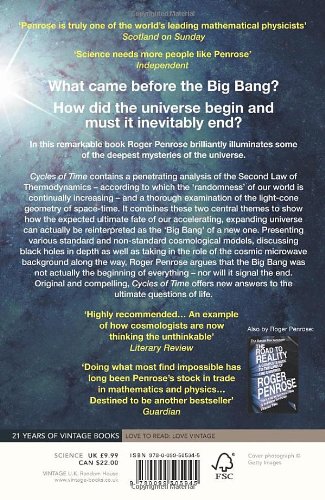
Sir Roger Penrose Cycles of Time: An Extraordinary New View of the Universe filetype pdf - Cycles of Time: An Extraordinary New View of the Universe a été écrit par Sir Roger Penrose qui connu comme un auteur et ont écrit beaucoup de livres intéressants avec une grande narration. Cycles of Time: An Extraordinary New View of the Universe a été l'un des livres de populer sur 2016. Il contient 304 pages et disponible sur format . Ce livre a été très surpris en raison de sa note rating et a obtenu environ avis des utilisateurs. Donc, après avoir terminé la lecture de ce livre, je recommande aux lecteurs de ne pas sous-estimer ce grand livre. Vous devez prendre Cycles of Time: An Extraordinary New View of the Universe que votre liste de lecture ou vous serez regretter parce que vous ne l'avez pas lu encore dans votre vie.Rang parmi les ventes Amazon: #87072 dans LivresPublié le: 2011-07-28Sorti le: 2011-07-28Langue d'origine: AnglaisNombre d'articles: 1Dimensions: 7.75" h x .88" l x 5.10" L, 1.43 livres Reliure: Broché304 pagesExtraitPREFACEOne of the deepest mysteries of our universe is the puzzle of whence it came. When I entered Cambridge University as a mathematics graduate student, in the early 1950s, a fascinating cosmological theory was in the ascendant, known as the steady-state model. According to this scheme, the universe had no beginning, and it remained more-or-less the same, overall, for all time. The steady-state universe was able to achieve this, despite its expansion, because the continual depletion of material arising from the universe’s expansion is taken to be compensated by the continual creation of new material, in the form of an extremely diffuse hydrogen gas. My friend and mentor at Cambridge, the cosmologist Dennis Sciama, from whom I learnt the thrill of so much new physics, was at that time a strong proponent of steady-state cosmology, and he impressed upon me the beauty and power of that remarkable scheme of things. Yet this theory has not stood the test of time. About 10 years after I had first entered Cambridge, and had become well acquainted with the theory, Arno Penzias and Robert Wilson discovered, to their own surprise, an all-pervading electromagnetic radiation, coming in from all directions, now referred to as the cosmic microwave background or CMB. This was soon identified, by Robert Dicke, as a predicted implication of the ‘flash’ of a Big-Bang origin to the universe, now presumed to have taken place some 14 thousand million years ago—an event that had been first seriously envisaged by Monsignor Georges Lemaître in 1927, as an implication of his work on Einstein’s 1915 equations of general relativity and early observational indications of an expansion of the universe. With great courage and scientific honesty (when the CMB data became better established), Dennis Sciama publicly repudiated his earlier views and strongly supported the idea of the Big Bang origin to the universe from then on. Since that time, cosmology has matured from a speculative pursuit into an exact science, and intense analysis of the CMB—coming from highly detailed data, generated by numerous superb experiments—has formed a major part of this revolution. However, many mysteries remain, and much speculation continues to be part of this endeavour. In this book, I provide descriptions not only of the main models of classical relativistic cosmology but also of various developments and puzzling issues that have arisen since then. Most particularly, there is a profound oddness underlying the Second Law of thermodynamics and the very nature of the Big Bang. In relation to this, I am putting forward a body of speculation of my own, which brings together many strands of different aspects of the universe we know. My own unorthodox approach dates from the summer of 2005, though much of the detail is more recent. This account goes seriously into some of the geometry, but I have refrained from including, in the main body of the text, anything serious in the way of equations or other technicalities, all these being banished to the Appendices. The experts, only, are referred to those parts of the book. The scheme that I am now arguing for here is indeed unorthodox, yet it is based on geometrical and physical ideas which are very soundly based. Although something entirely different, this proposal turns out to have strong echoes of the old steady-state model! I wonder what Dennis Sciama would have made of it.Revue de presse"Penrose is truly one of the world's leading mathematical physicists" (Scotland on Sunday)"Science needs more people like Penrose, willing and able to point out the flaws in fashionable models from a position of authority, and to signpost alternative roads to follow" (Independent)"A genuinely new idea about the origins of the universe that, although untested, seems to hold together theoretically and must be taken seriously given Penrose's status" (Doug Johnstone Scotsman)"Cycles of Time can be highly recommended as an example of how cosmologists are now thinking the unthinkable by trying to look back beyond the Big Bang and forward beyond the death of our universe" (Literary Review)"Cycles of Time is as uncondescending in style and as impenetrable in content as his previous books. Which is not to say that there are not, as before, many pleasures to be had along the way" (Sunday Times)Présentation de l'éditeurWhat came before the Big Bang? How did the universe begin and must it inevitably end? In this remarkable book Roger Penrose brilliantly illuminates some of the deepest mysteries of the universe. Cycles of Time contains a penetrating analysis of the second law of thermodynamics - according to which the 'randomness' of our world is continually increasing - and a thorough examination of the light-cone geometry of space-time. It combines these two central themes to show how the expected ultimate fate of our accelerating, expanding universe can actually be reinterpreted as the 'big bang' of a new one. Presenting various standard and non-standard cosmological models, discussing black holes in depth as well as taking in the role of the cosmic microwave background along the way, Roger Penrose argues that the Big Bang was not actually the beginning of everything - nor will it signal the end.Original and compelling, Cycles of Time offers new answers to the ultimate questions of life.
Détails de Cycles of Time: An Extraordinary New View of the Universe
Titre du livre : Cycles of Time: An Extraordinary New View of the Universe
Auteur : Sir Roger Penrose
ISBN-10 : 0099505940
Date de sortie : 2011-07-28
Catégorie : Science
Nom de fichier : cycles-of-time-an-extraordinary-new-view-of-the-universe.pdf
Taille du fichier : 28.51 (La vitesse du serveur actuel est 29.55 Mbps
Si vous avez un intérêt pour Cycles of Time: An Extraordinary New View of the Universe, vous pouvez également lire un livre similaire tel que cc The Nature of Space and Time, The Road to Reality: A Complete Guide to the Laws of the Universe, Shadows Of The Mind: A Search for the Missing Science of Consciousness, Fashion, Faith, and Fantasy in the New Physics of the Universe

No comments:
Post a Comment